Ruby Ball Lens: The Definitive Guide to Properties, Applications, and Selection
Welcome to the comprehensive resource on ruby ball lens technology, brought to you by Hengyuan. Whether you are an engineer designing a fiber optic coupling system, a medical device manufacturer, or a researcher needing precise light collimation, understanding the nuances of ruby ball lenses is critical. This guide will walk you through everything from material composition to advanced applications, ensuring you have the technical knowledge to make the best choice for your optical systems.
1. What is a Ruby Ball Lens? Material and Core Properties
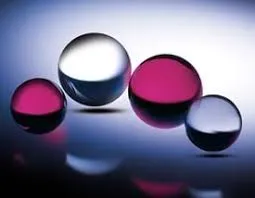
A ruby ball lens is a spherical optical component made from high-purity aluminum oxide (Al₂O₃), commonly known as sapphire, that is doped with chromium oxide (Cr₂O₃). It is this chromium content—typically exceeding 0.5%—that gives the lens its characteristic red color and the name “ruby.” At HengYuan, we leverage the superior qualities of ruby to manufacture ball lenses that are not only visually distinct but also mechanically robust.
Why Choose Ruby Over Standard Glass or Sapphire?
While both sapphire and ruby share similar physical and chemical properties, ruby ball lenses offer a practical advantage: they are significantly easier to see and handle during assembly and cleaning processes. This makes them ideal for physical applications where visual identification is key. However, it is important to note that sapphire has superior optical transmission across a broader spectrum, whereas ruby provides enhanced visibility at a slight trade-off in transmission. For most industrial applications, the durability and handling ease of a ruby ball lens make it the preferred choice.
Key Technical Specifications at a Glance (HengYuan Standards)
| Property | Value / Specification |
|---|---|
| Material | Ruby-Doped Sapphire (Al₂O₃ + Cr₂O₃) |
| Specific Gravity (g/cm³) | 3.98 |
| Refractive Index (nd) | 1.77 |
| Compressive Strength (psi) | 300,000 |
| Diameter Tolerance (μm) | ±2.54 (custom tolerances available down to ±0.001mm) |
| Sphericity (μm) | 0.625 (standard), up to 0.001 for high-precision) |
| Melting Temperature (°C) | 2053.00 |
| Coefficient of Thermal Expansion (10⁻⁶/°C) | 8.4 |
| Surface Quality (Scratch-Dig) | 20-10 (customizable from 80/50 to 10/5) |
2. Key Industries and Applications of Ruby Ball Lenses
The unique combination of high strength, extreme hardness, and chemical stability makes the ruby ball lens indispensable in severe environments where standard glass lenses would fail. Below are the primary industries and applications where HengYuan’s ruby ball lenses excel.
2.1 Fiber Optic Communications and Coupling
One of the most common uses of a ball lens is to improve signal coupling between fibers, emitters, and detectors. In fiber coupling applications, a single ruby ball lens can efficiently couple a laser beam into an optical fiber. For coupling two optical fibers, two identical ball lenses are placed in sequence. The high refractive index (1.77) of ruby allows for a short back focal length, minimizing the distance needed between the ball lens and the optical fiber. This results in a compact, high-coupling-efficiency system that is easy to align.
2.2 Medical and Bio-Engineering: Endoscopy and Microscopy
In the medical field, precision and reliability are non-negotiable. Ruby ball lenses are extensively used in endoscopy and microscopy. Their high hardness and resistance to autoclaving (sterilization) make them suitable for reusable medical devices. Furthermore, the clear red color helps technicians identify the lens within complex instrument assemblies. HengYuan supplies ruby ball lenses for laser measurement systems, optical pick-up devices, and other diagnostic equipment where consistent optical performance is critical.
2.3 Industrial Sensors and Harsh Environments
Many industrial applications involve high temperature, high pressure, or corrosive environments. Traditional optical materials may degrade, but a ruby ball lens maintains its integrity. Common applications include:
- Bar code scanning: Miniature optics for rugged scanners used in warehouses and logistics.
- Ball pre-forms for aspheric lenses: Ruby balls serve as precise starting blanks for grinding complex aspheric shapes.
- Sensor applications: In oil & gas downhole sensors, where temperatures can exceed 200°C.
- High-temperature applications: Such as furnaces and combustion monitoring.
2.4 Aerospace and Defense
Given their high compressive strength (300,000 psi) and zero porosity, ruby ball lenses are often specified for targeting systems, avionics displays, and gyroscopes. Their ability to withstand severe vibration and thermal shock without cracking is a major advantage.
3. Deep Dive: Technical Advantages of Ruby Ball Lenses
When evaluating a ruby ball lens for your project, understanding its optical physics and mechanical advantages is key. A ball lens functions equivalently to two plano-convex lenses separated by a parallel plane. The performance is dictated by the ratio of the ball diameter (D) to the input source diameter (d). As the d/D ratio increases, the focus spot size at the back focal length also increases – a factor known as spherical aberration.
Advantage 1: Exceptional Chemical and Thermal Stability
Ruby is chemically inert. It does not react with most acids, alkalis, or solvents. This high chemical stability, combined with a melting temperature of 2053°C, ensures that HengYuan’s ruby ball lenses can be used in the most demanding processes without degradation. The coefficient of thermal expansion (8.4 x 10⁻⁶/°C) is well-matched to metal seals, reducing thermal stress at mounting interfaces.
Advantage 2: Superior Mechanical Strength
With a compressive strength of 300,000 psi and extreme hardness, ruby ball lenses are almost impossible to scratch or crack under normal handling. This durability translates to longer component life and lower replacement costs in vibrating machinery or portable equipment.
Advantage 3: High Index of Refraction for Compact Designs
At 1.77, the refractive index of ruby is significantly higher than that of BK7 glass (≈1.51) or standard fused silica. This allows optical designers to achieve the same numerical aperture (NA) and focal length with a smaller-diameter ball lens. For applications where space is at a premium – such as in smartphone cameras or micro-endoscopes – this is a game-changer.
4. A Practical Guide to Selecting the Right Ruby Ball Lens
Choosing the correct ruby ball lens for your fiber coupling or detection system involves several calculations. Below is a simplified selection guide from HengYuan’s engineering team.
Step 1: Determine the Numerical Aperture (NA)
For laser-to-fiber coupling, the numerical aperture of the ball lens must be less than or equal to the numerical aperture (NA) of the fiber. For example, if you are working with a fiber that has an NA of 0.22, you need a ruby ball lens with an NA of no more than 0.22. The formula is:
NA = n * sin(θ), where n is the refractive index (1.77 for ruby) and θ is the half-acceptance angle.
Step 2: Calculate the Back Focal Length (BFL)
The BFL is the distance from the back surface of the ball lens to the focal point. For a ball lens, the effective focal length (EFL) is approximately EFL = (n * D) / (4 * (n – 1)). The BFL is the distance from the lens surface to the focus. Generally, the ball lens should be placed one BFL distance in front of the fiber or detector.
Step 3: Define Diameter and Tolerances
HengYuan manufactures ruby ball lenses in diameters ranging from as small as 0.50mm to 150mm. Standard diameter tolerances are ±2.54μm, but for ultra-high precision applications (such as for waveguides), we can achieve tolerances of ±0.001mm to ±0.003mm with sphericity as tight as 0.001mm. Consider your alignment equipment and mounting fixtures when specifying tolerance – tighter tolerances reduce insertion loss but increase cost.
Quick Selection Table for Common Diameters (HengYuan Stock Program)
| Diameter (mm) | Typical Application | Stock Status |
|---|---|---|
| 1.00 mm | Miniature barcode scanners, medical sensors | Usually in stock |
| 1.50 mm | Fiber coupling (single-mode) | Usually in stock |
| 2.00 mm | Endoscopy illumination, laser collimation | Made to order |
| 3.00 mm | Multi-mode fiber coupling, sensors | Usually in stock |
| 5.00 mm | R&D testing, aspheric pre-forms | Made to order |
| 9.525 mm (3/8″) | Industrial instrumentation, high-power lasers | Made to order |
5. Why Partner with HengYuan for Your Ruby Ball Lens Needs?
While many suppliers offer off-the-shelf lenses, HengYuan differentiates itself through rigorous quality control, custom manufacturing capabilities, and a deep understanding of optical materials. Our facility is equipped to handle everything from prototype to volume/OEM quantities.
Custom Manufacturing and Rapid Prototyping
We understand that not every application fits a standard catalog. HengYuan offers comprehensive custom manufacturing services for ruby ball lenses and ruby half-ball lenses (hemispheres). Our capabilities include:
- Custom dimensions (any diameter from 0.001mm to 150mm).
- Custom coatings (AR coatings for specific wavelengths, high-reflection coatings).
- Tight tolerances and complex geometries (including half-ball lenses with a flat surface for easy mounting).
- Scalable production from 1 piece to 5,000,000 pieces per month.
Quality Assurance in Class 100 Clean Rooms
All HengYuan ruby ball lenses are inspected and packaged in a Class 100 clean room facility. This ensures zero porosity and defect-free surfaces. For customers with automatic pick-and-place systems, we provide lenses in waffle-type plastic trays. For bulk quantities, we use anti-static plastic vials or clean glass vials.
Cost-Effective Solutions
By controlling our raw material supply chain for high-purity alumina and chromium oxide, we minimize wastage and pass the savings on to you. Whether you need 10 lenses for a prototype or 100,000 for mass production, contact us for discount pricing for volume orders.
6. Ruby Half-Ball Lenses: An Alternative for Easy Mounting
In addition to full spheres, HengYuan manufactures ruby half-ball lenses (also known as hemispheres). These components feature a very short back focal length combined with the convenience of a flat surface, making them incredibly easy to mount on a substrate or directly onto a fiber optic connector. They are ideal for applications requiring high precision in a compact form factor, such as laser diode collimation and optical pick-up devices.
7. Real-World Case Study: Improving Fiber Coupling Efficiency
Scenario: A client was building a high-power industrial laser system and was experiencing 35% coupling loss using standard BK7 ball lenses. The loss was caused by thermal drift and misalignment due to vibration.
Solution: HengYuan recommended a 3.00mm diameter ruby ball lens with a high compressive strength and lower thermal expansion mismatch.
Result: The client saw an immediate improvement. Coupling efficiency increased to 92% (a 27% absolute improvement). The ruby lens withstood the laser power without solarization, and the system required 50% less frequent realignment. The red color of the ruby lens also allowed the assembly technicians to visually verify placement before welding, reducing assembly errors by 15%.
8. Conclusion: Elevate Your Optical System with HengYuan Ruby Ball Lenses
From the harsh environment of downhole drilling to the precise world of medical endoscopy, the ruby ball lens stands out as a superior component. Its unique combination of high hardness, chemical stability, high refractive index (1.77), and physical durability (thanks to Al₂O₃ and Cr doping) solves problems that glass alone cannot. Whether you need a standard 1.00mm ball for a fiber coupling application or a custom half-ball lens for a sensor, HengYuan has the engineering expertise and manufacturing scale to deliver.
Remember to consider the numerical aperture (NA) and back focal length in your design, and don’t hesitate to leverage our custom options for coatings or tight tolerances. For stock parts, volume pricing, or custom drawings, we are ready to assist.
Ready to Discuss Your Project? Contact HengYuan Today
Have technical questions? Need a quote for 10+ pieces or OEM quantities? Send us your drawing or specification. Our engineers are available for free consultations.
Email: melissa@hyadvancedmaterials.com
WhatsApp: +8619112802255
Web: hyadvancedmaterials.com (For secure communications)
