Ruby Balls Manufacturing Factory – High Precision Synthetic Ruby Balls Manufacturer
When industries require exceptional hardness, dimensional stability, corrosion resistance, and ultra-precise spherical components, synthetic ruby balls become the preferred solution. As a professional ruby balls manufacturing factory, Hengyuan Medical specializes in producing high precision ruby balls, ruby bearing balls, ruby spheres, sapphire balls, and custom ceramic balls designed for demanding industrial applications worldwide.
Our precision ruby balls are manufactured from synthetic monocrystalline aluminum oxide (Al₂O₃) doped with chromium, delivering outstanding wear resistance, superior surface finish, excellent thermal stability, and long service life. These characteristics make ruby balls ideal for aerospace systems, medical devices, optical instruments, semiconductor equipment, flow control systems, pumps, valves, flow meters, measurement instruments, laser equipment, and precision bearing assemblies.
With advanced grinding technology, precision polishing processes, and strict quality control standards, Hengyuan Medical supplies custom ruby balls to customers seeking reliability, durability, and micron-level accuracy.
What Are Ruby Balls?
- Precision Bearings & Valves: Used in flow meters, aerosol pumps, and specialized valves requiring corrosion and friction resistance.
- Metrology & Probes: Serve as the contact tips on Coordinate Measuring Machines (CMMs) and optical probing devices.
- Optics & Lasers: Leveraged as ball lenses in laser-based positioning systems, fiber optics, and advanced sensor arrays.
- Biomedical Devices: Utilized in high-wear or corrosive diagnostic and experimental machinery.
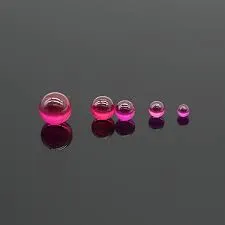
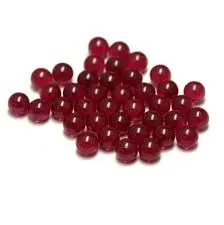
Ruby balls are ultra-hard precision spheres manufactured from synthetic ruby crystal. Synthetic ruby belongs to the corundum family and consists primarily of aluminum oxide (Al₂O₃) with trace chromium additions that provide its distinctive red color.
Compared with traditional steel balls and many ceramic balls, synthetic ruby balls offer:
• Mohs Hardness: 9
• Excellent Wear Resistance
• Outstanding Corrosion Resistance
• High Mechanical Strength
• Superior Thermal Stability
• Excellent Chemical Resistance
• High Surface Finish Quality
• Exceptional Dimensional Stability
• Low Friction Performance
• Long Service Life
Because of these properties, ruby balls are commonly used as:
– Ruby Bearing Balls
– Precision Ruby Spheres
– Valve Balls
– Flow Meter Balls
– Jewel Bearing Components
– Optical Alignment Components
– Semiconductor Equipment Parts
– Medical Device Components
As a leading ruby balls manufacturing factory, Hengyuan Medical provides both standard and custom ruby balls for global industrial customers.
Key Material Properties of Synthetic Ruby Balls
- Hardness: Ranks 9 on the Mohs scale, and between 1,800 and 2,200 on the Knoop scale, making it one of the hardest materials second only to diamond.
- Compressive Strength: Highly resistant to compression, measuring around 2.1 GPa.
- Young’s Modulus: Approximately 340 to 440 GPa, ensuring high rigidity and resistance to elastic deformation.
- Wear & Abrasion Resistance: The extreme durability of the crystalline corundum structure makes them perfect for high-friction environments.
- Melting Point: Exceptionally high, at approximately 2050°C.
- Thermal Stability: Exhibits outstanding dimensional stability across extreme temperature fluctuations.
- Thermal Conductivity: Measures approximately 40 W/m·K at room temperature, allowing for good heat dissipation.
- Coefficient of Linear Thermal Expansion: anisotropic, expanding slightly depending on the crystalline axis (5.4 × 10⁻⁶ to 6.2 × 10⁻⁶ /°C).
- Inertness: Chemically stable and highly resistant to most acids, alkalis, and organic solvents, even at elevated temperatures.
- Porosity: Non-porous, meaning it will not absorb liquids, outgas, or leach microscopic particles.
- Refractive Index: Anisotropic with an ordinary ray of around 1.76.
- Optical Transparency: High optical clarity for visible, infrared, and ultraviolet (UV) light, making them suitable for optical alignment tools and laser systems.
- Electrical Resistivity: High electrical resistivity, functioning as an effective electrical insulator.
- What industry or application are you designing for (e.g., optical alignment, CMM inspection, or check valves)?
- What is the required ball diameter or tolerance you need?
Synthetic ruby is considered one of the most reliable engineering materials available for precision sphere manufacturing.
| Property | Value |
|---|---|
| Material | Synthetic Ruby (Al₂O₃ + Cr) |
| Hardness | Mohs 9 |
| Density | 3.97 g/cm³ |
| Compressive Strength | >2000 MPa |
| Young’s Modulus | 345 GPa |
| Melting Point | 2050°C |
| Thermal Conductivity | 35 W/m·K |
| Chemical Resistance | Excellent |
| Corrosion Resistance | Excellent |
| Electrical Insulation | Excellent |
Ruby Balls Manufacturing Process
- Powder Preparation: Highly pure aluminum oxide (Al₂O₃) powder is thoroughly mixed with a precise trace amount of chromium oxide (Cr₂O₃), which provides the signature red color.
- The Verneuil Process (Flame Fusion): Most commonly, the powder is dropped through a high-temperature oxygen-hydrogen flame (> 2,000°C). The melted droplets fall onto a rotating pedestal, where they crystallize into a single-crystal, pear-shaped cylinder called a boule.
- Annealing: The boule is slowly cooled in a kiln to relieve any internal stresses and prevent fracturing.
- Cutting and Preforming: The grown ruby boule is sliced into smaller blanks or rods using diamond saws. These rough blanks are then pre-shaped into imperfectly rounded cubes or cylinders.
- Rough Grinding: The blanks are loaded into specialized centerless grinding machines that use abrasive wheels (often diamond or boron carbide). The balls are tumbled in grooves between rotating discs until they take on a roughly spherical shape.
- Lapping: The rough balls are transferred to lapping machines where they undergo continuous rolling between grooved cast-iron plates with an abrasive slurry. This refines the diameter and significantly improves the roundness.
- Polishing: To achieve extreme optical clarity and a mirror-like, scratch-free surface, the balls go through a final polishing stage using ultra-fine diamond powders.
- Cleaning and Quality Control: The finished ruby balls are typically inspected and packaged in Class 100 clean rooms. Optical microscopes and laser interferometers are used to verify sphericity, checking to tolerances as tight as ± 0.0025 mm (Grade 25).
- What is the intended application (e.g., valves, optical lenses, or probing tips)?
- What diameter or size range do you need?
- Do you have any strict requirements regarding sphericity tolerances?
At Hengyuan Medical, every ruby ball undergoes a highly controlled manufacturing process to ensure exceptional precision and consistency.
1. Raw Material Selection
Only premium-grade synthetic ruby crystals are selected. Material purity directly affects wear resistance, dimensional accuracy, and long-term performance.
2. Precision Cutting
Synthetic ruby rods are cut into blanks with strict dimensional controls before entering grinding operations.
3. Precision Grinding
Advanced grinding equipment shapes each ruby sphere to near-perfect geometry. This stage establishes ball roundness and diameter consistency.
Keywords naturally covered:
– Precision Ruby Balls
– Ruby Ball Manufacturing
– Ruby Sphere Manufacturing
– Synthetic Ruby Balls
– Industrial Ruby Balls
4. Ultra-Fine Polishing
Multi-stage polishing technology produces mirror-like surfaces with extremely low roughness values. This process significantly improves bearing performance and reduces friction.
5. Inspection and Quality Control
Every production batch undergoes rigorous inspection including:
– Diameter Verification
– Roundness Measurement
– Surface Defect Analysis
– Optical Inspection
– Sorting and Grading
– Cleanroom Packaging
Available Sizes and Precision Grades
| Diameter Range | Precision Grade | Application |
|---|---|---|
| 0.30 mm | G3-G10 | Micro Bearings |
| 0.50 mm | G3-G10 | Medical Devices |
| 1.00 mm | G3-G25 | Flow Meters |
| 2.00 mm | G3-G25 | Valves |
| 3.00 mm | G3-G50 | Instrumentation |
| 5.00 mm | G3-G50 | Optical Systems |
| 10.00 mm | G10-G100 | Industrial Equipment |
Custom diameters and special tolerances are available upon request.
- Micro/Miniature (0.12 mm – 3.0 mm): Used in watchmaking, delicate stylus tips, and precision fiber-optic or optical assemblies.
- Medium/Standard (4.0 mm – 10.0 mm): Frequently used for CMM (Coordinate Measuring Machine) inspection probes, chromatography pumps, and high-precision check valves.
- Large (12.0 mm – 25.4 mm+): Reserved for demanding fluid handling systems and heavy-duty industrial or aerospace applications.
- Grade 3: The highest precision, allowing for a sphericity tolerance of roughly 0.08 μ m. Ideal for highly accurate metrology styli.
- Grade 5: Sphericity is typically accurate to within 0.13 μ m.
- Grade 25: Sphericity is typically accurate to within 0.625 μ m. This is the most common industry-standard tier for mechanical bearings and high-performance instruments.
- Grade 50 to 100: Good for general industrial and flow-valve uses where tighter tolerances are unnecessary.
- What size and tolerance (grade) do you require?
- Are you looking for solid spheres or custom-drilled balls?
- What is the intended application (e.g., fluid handling, CMM probes, or specialized lenses)?
Ruby Balls vs Sapphire Balls
| Feature | Ruby Balls | Sapphire Balls |
|---|---|---|
| Base Material | Al₂O₃ + Chromium | Pure Al₂O₃ |
| Hardness | Mohs 9 | Mohs 9 |
| Wear Resistance | Excellent | Excellent |
| Corrosion Resistance | Excellent | Excellent |
| Precision Manufacturing | Excellent | Excellent |
| Industrial Applications | Extensive | Extensive |
Both sapphire balls and ruby balls belong to the corundum family and provide exceptional performance in high-precision industrial environments.
| Feature | Ruby Balls | Sapphire Balls |
|---|---|---|
| Material | Synthetic corundum with trace chromium | Pure synthetic corundum (aluminum oxide) |
| Color | Deep red | Colorless / Transparent |
| Visibility / Contrast | High visual contrast, making them easier to track in clear fluids or complex mechanical assemblies. | Invisible or highly camouflaged in clear optical liquids or precision lenses. |
| Primary Use Cases | Ball vapes (dabbing/dry herb), visual flow meters, precision check valves. | Optical instruments, medical lasers, fiber optic connectors, and endoscopes. |
- Extreme Hardness: At 9 on the Mohs scale, they are second only to diamond.
- Thermal Stability: Both have a melting point above 2,000°C and are immune to extreme thermal shock.
- Chemical Inertness: They are impervious to most acids, solvents, and detergents.
- Zero Porosity: Highly spherical with a low coefficient of friction, making them non-magnetic and long-lasting in continuous-wear applications.
Which one do you choose?
- For Industrial & Optical Engineering: Sapphire balls are traditionally preferred for optics, lasers, and fiber optics due to their perfect transparency.
- For Dabbing / Ball Vapes: Ruby balls (often referred to as terp pearls) are the standard. Their rich color offers high contrast, allowing users to easily track the balls as they spin inside a quartz banger.
