Ruby Ball Lens Manufacturer | High Precision Optical Ruby Ball Lens Supplier – HENGYUAN
What is a Ruby Ball Lens?
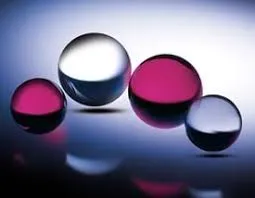
In optical engineering, ruby ball lenses are widely classified under ball lens optics and are used for light coupling, focusing, and collimation. They are especially effective in compact optical systems where alignment tolerance is critical.
The refractive index of ruby ball lenses is typically around 1.77, enabling efficient light transmission in fiber coupling and sensor applications.
Material Properties of Ruby Ball Lens (Ruby-Doped Sapphire Al2O3)
Key Material Characteristics
– Refractive Index: ~1.77
– Wavelength Range: 0.2 – 5.5 μm (depending on grade)
– Compressive Strength: up to 300,000 psi
– Coefficient of Thermal Expansion: ~8.4 × 10⁻⁶/°C
– Sphericity: typically ±0.625 μm class precision
– Diameter Tolerance: ±2.5 μm (high precision grade)
These parameters make ruby ball lenses suitable for harsh environments, high temperature optics, and precision photonics systems.
Optical Performance of Ruby Ball Lens
Key Optical Features
– Short back focal length for compact optical assemblies
– Low signal loss in optical transmission paths
– Suitable for UV to NIR wavelength systems
– Minimal optical degradation under thermal stress
In many designs, ruby ball lenses are paired with emitters, detectors, or optical fibers to maximize signal transfer efficiency.
Ruby Ball Lens vs Sapphire Ball Lens
Main Differences
– Sapphire ball lens: higher optical transmission in some wavelength ranges
– Both materials: similar hardness, chemical stability, and thermal resistance
In industrial optical systems, sapphire is often chosen for maximum transmission, while ruby is preferred when visual alignment and assembly convenience are important.
Ruby Ball Lens Sizes & Types
Common Product Types
– Standard ruby ball lens (0.5 mm – 6 mm)
– Ruby half-ball lens (for compact mounting systems)
– Large diameter ruby optical spheres (custom up to 60+ mm)
Technical Table (Typical Specifications)
Material: Ruby-doped sapphire (Al2O3)
Refractive Index: 1.77
Surface Quality: 20-10 to 40-20 scratch/dig
Sphericity: ≤0.625 μm
Tolerance: ±2.5 μm (precision grade)
Ruby Ball Lens Applications
1. Fiber Optic Communication
2. Medical & Endoscopy Systems
3. Barcode Scanning & Sensing
4. Laser & Photonics Systems
5. Industrial & High-Temperature Environments
Advantages of HENGYUAN Ruby Ball Lens
Core Advantages
– Stable optical performance under heat and pressure
– Excellent chemical resistance
– High precision manufacturing (micron-level tolerance)
– Custom diameter and OEM production capability
– Suitable for UV, visible, and infrared systems
Compared with standard optical glass lenses, ruby ball lenses provide significantly better durability and long-term stability in industrial environments.
Selection Guide for Ruby Ball Lens
1. Diameter Size
2. Optical Requirements
3. Environmental Conditions
4. Application Type
HENGYUAN Custom Ruby Ball Lens Manufacturing
We support:
– Custom diameter production
– OEM optical component manufacturing
– Precision polishing and sphericity control
– Small batch to mass production supply
Contact Us
Email: melissa@hyadvancedmaterials.com
WhatsApp: +8619112802255
Website: hyadvancedmaterials.com
