Precision Ruby Balls Factory: Hengyuan Advanced Materials
Welcome to Hengyuan, a professional precision ruby balls factory dedicated to the manufacture of high-accuracy synthetic sapphire and ruby components. Unlike standard steel or ceramic alternatives, our synthetic ruby balls (Al₂O₃:Cr) offer an optimal balance of extreme hardness, wear resistance, and dimensional stability. As a true factory rather than a distributor, we provide direct access to precision manufacturing, from raw material formulation to final quality certification, ensuring traceability and cost efficiency for global clients.
1. What Are Precision Ruby Balls? Material & Composition
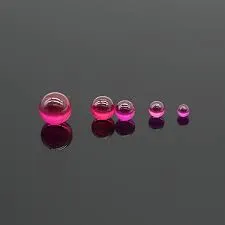
Precision ruby balls are ultra-hard, non-magnetic spheres produced from monocrystalline aluminum oxide (Al₂O₃) doped with trace chromium (Cr), which gives them a distinctive red color. At Hengyuan, we manufacture these synthetic ruby spheres using controlled crystal growth processes, ensuring consistent sphericity and surface integrity. The resulting material achieves a Mohs hardness of 9, second only to diamond, with exceptional resistance to corrosion, galling, and chemical attack. This makes our ruby balls far more durable than stainless steel (e.g., 440C or 316) in high-cycle environments, while remaining chemically inert for demanding fluid control systems.
2. Key Technical Specifications & Precision Grades
As a precision ruby balls factory, Hengyuan adheres to international ball standards including ISO 3290, AFBMA Std. 10, and DIN 5401. Our ruby balls are available in grades from Grade 3 to Grade 500, with typical tolerances that meet or exceed bearing industry requirements.
Typical Technical Parameters (Grade 5 – Grade 10)
- Ball Diameter Variation (Sphericity): ≤ 0.13 µm (Grade 5) / ≤ 0.25 µm (Grade 10)
- Surface Roughness (Ra): ≤ 0.02 µm (Grade 5) / ≤ 0.025 µm (Grade 10)
- Diameter Tolerance per Ball: ±0.13 µm (Grade 5) / ±0.25 µm (Grade 10)
- Lot Diameter Variation: ≤ 0.25 µm (Grade 5) / ≤ 0.50 µm (Grade 10)
- Available Size Range: 0.35 mm to 15 mm (custom diameters up to 25 mm on request)
Comparison Table: Ruby Balls vs. Common Ball Materials
| Property | Hengyuan Ruby (Al₂O₃:Cr) | Chrome Steel (AISI 52100) | Stainless Steel (440C) | Silicon Nitride (Si₃N₄) |
|---|---|---|---|---|
| Hardness (HV) | ~2400 | 58-62 HRC (~700 HV) | 56-60 HRC (~650 HV) | ~1600 |
| Corrosion Resistance | Excellent (Inert) | Poor (Rusts) | Good (but prone to pitting) | Excellent |
| Magnetic | Non-magnetic | Magnetic | Magnetic (slightly) | Non-magnetic |
| Density (g/cm³) | 3.98 | 7.82 | 7.75 | 3.20 |
| Max Operating Temp (°C) | >1800 | ~350 | ~400 | ~1100 |
| Cost Level | Medium-High | Low | Low-Medium | High |
3. Industry Applications & Real-World Use Cases
The unique combination of wear resistance, dimensional accuracy, and chemical inertness makes Hengyuan’s precision ruby balls ideal for critical applications across multiple industries. Below are detailed use cases from our existing customers.
3.1 Medical & Chemical Pump Check Valves and Metering Valves
Application case: A leading manufacturer of insulin pumps replaced 316 stainless steel balls with Hengyuan 1.5mm ruby balls (Grade 10). The result: valve life extended from 3 months to over 18 months without leakage. Ruby balls provide a perfect spherical seat, reducing backflow and ensuring precise dosage in critical care devices. They are widely used in check valves, metering valves, and flow meters where abrasion resistance directly impacts service life.
3.2 Precision Metrology & Touch Probes
Application case: A European CMM (coordinate measuring machine) producer adopted Hengyuan 3mm ruby stylus tips. The high hardness (Mohs 9) and low surface roughness (Ra ≤0.02µm) reduce tip wear by 70% compared to tungsten carbide, maintaining measurement repeatability over millions of cycles. Our ruby balls are standard components in metrology tips, test probes, and stylus balls for automotive and aerospace inspection.
3.3 Miniature Bearings & Non-Magnetic Assemblies
For applications requiring non-magnetic, corrosion-resistant rolling elements, Hengyuan ruby balls are an excellent choice. An aerospace sensor manufacturer uses our 0.8mm ruby spheres in a gimbal bearing assembly, eliminating magnetic interference and providing smooth rotation with minimal friction. They are also used in hybrid ceramic bearings for high-speed spindles and vacuum pumps.
3.4 Flow Control & Chemical Processing Equipment
In aggressive chemical environments—acids, alkalis, and solvents—metal balls quickly corrode or gall. Hengyuan ruby balls remain inert. A chemical pump OEM standardized on 6mm ruby balls for their diaphragm pump metering valves, resulting in zero fluid contamination and maintenance intervals doubled. Typical applications include chemical pumps, spray guns, and liquid dispensing equipment.
4. Why Choose Hengyuan as Your Precision Ruby Balls Factory?
Selecting a genuine precision ruby balls factory like Hengyuan delivers measurable advantages over trading companies or generic bearing suppliers.
Factory-Direct Benefits:
- IATF 16949:2016 Certified Quality System – Our manufacturing processes meet stringent automotive-level process controls, ensuring batch-to-batch consistency. We apply CQI-9 heat treatment protocols (where applicable) and advanced inspection equipment.
- Complete In-House Production – From crystal growth to final lapping and polishing, all critical steps are under one roof. This allows tight control over sphericity, lot diameter variation, and surface roughness.
- Customization Capabilities – Beyond standard sizes, we offer modified balls (half-balls, drilled balls with blind or through holes, balls on shafts/stems) and special tolerance grades per customer drawings.
- Large Capacity & Short Lead Times – With daily output measured in tons for steel and ceramic balls, and dedicated lines for ruby products, we support both prototype orders (as few as 100 pieces) and high-volume programs (millions of pieces) with 15-20 day delivery.
- Full Traceability & Documentation – Each lot is accompanied by certificates of calibration, material composition reports, and dimensional inspection data traceable to international standards.
5. Technical Data: Ball Grades & Tolerances (ISO 3290 / AFBMA 10)
Hengyuan manufactures ruby balls according to globally recognized specifications. Below is a reference table for common precision grades. Contact us for detailed grade 3, 5, 10, 25, and 50 availability.
| Grade | Ball Diameter Variation (µm) max | Sphericity (µm) max | Surface Roughness Ra (µm) max | Lot Diameter Variation (µm) max | Typical Applications |
|---|---|---|---|---|---|
| Grade 3 | 0.08 | 0.08 | 0.012 | 0.13 | Ultra-high precision bearings, reference masters |
| Grade 5 | 0.13 | 0.13 | 0.02 | 0.25 | High-end metrology, aerospace valves |
| Grade 10 | 0.25 | 0.25 | 0.025 | 0.50 | Medical pumps, flow meters, instrument bearings |
| Grade 25 | 0.64 | 0.64 | 0.05 | 1.25 | Industrial check valves, automotive components |
| Grade 50 | 1.27 | 1.27 | 0.075 | 2.50 | General industrial wear parts, non-critical bearings |
6. Ruby Balls vs. Sapphire, Glass & Other Materials: A Selection Guide
Engineers often ask: when to choose ruby over synthetic sapphire, precision glass, or silicon nitride?
- Synthetic Ruby vs. Sapphire: Both share identical hardness and wear resistance (Al₂O₃). Ruby’s chromium dopant provides a distinct red color for easy visual identification during assembly or inspection. Sapphire is clear/colorless. Otherwise, performance is the same. Hengyuan recommends ruby for applications where visual confirmation is beneficial (e.g., multi-ball assemblies).
- Ruby vs. Precision Glass Balls (Soda Lime / Borosilicate): Glass balls are cost-effective for low-load applications like level sensors or decorative uses, but they lack hardness (Mohs 5-6) and are prone to chipping. Ruby balls offer >10x wear life in abrasive or high-cycle environments.
- Ruby vs. Silicon Nitride (Si₃N₄): Si₃N₄ has lower density (better for high-speed bearings) and higher fracture toughness. However, ruby provides higher hardness and lower cost for most static or slow-speed contact applications like valve seats and metering probes. Ruby is also easier to metallize or bond for assembly.
- Ruby vs. Tungsten Carbide (Cobalt/Nickel Binder): TC balls are heavy and conductive. Ruby is non-magnetic, insulating, and chemically inert, making it superior for medical, electronic, and wet chemical environments. TC can suffer binder corrosion in water; ruby does not.
7. Buying Guide: How to Specify Precision Ruby Balls for Your Application
To ensure you receive the optimal ruby balls for your project, please provide the following parameters when requesting a quote from Hengyuan:
- Nominal diameter and tolerance (e.g., 1.588 mm ±0.5µm)
- Required grade (Grade 3, 5, 10, 25, 50, or custom)
- Quantity per lot (trial vs. production volume)
- Application environment (chemical exposure, temperature range, load cycles)
- Any special modifications (holes, flats, shafts, or other ball-related products like ball-ended plug gauges)
- Certification requirements (Certificates of Calibration, material certs, IATF 16949 compliance)
Our engineering team will then recommend the most cost-effective grade and size to meet your performance targets. For high-cycle applications (e.g., millions of operations), we often suggest Grade 10 or better ruby balls to maximize service life.
8. Quality Control & Metrology Equipment
As a specialized precision ruby balls factory, Hengyuan employs state-of-the-art inspection tools to verify each production lot:
- Laser micrometers for ball diameter and lot variation measurement
- Roundness testers (Talyrond) for sphericity analysis
- White light interferometry for surface roughness (Ra) verification
- Hardness testers (Vickers & Rockwell) for material consistency
Our quality control department rigorously checks statistically significant samples against ISO 3290, AFBMA Standard 10, and DIN 5401 requirements. We can supply certificates of calibration traceable to NIST or national metrology institutes upon request.
9. Case Study Summary: Performance Gains with Hengyuan Ruby Balls
- Medical pump OEM: Replaced 440C stainless balls with Hengyuan ruby → valve failure rate reduced by 92% → 3-year warranty extension.
- Chemical flow meter manufacturer: Switched from glass balls to ruby → service life in abrasive slurry increased from 6 weeks to 18 months.
- Aerospace metrology lab: Adopted Hengyuan Grade 5 ruby probe tips → calibration interval extended from 1 month to 6 months, saving $12,000/year.
10. Contact Hengyuan – Your Trusted Precision Ruby Balls Factory
Ready to improve the durability and accuracy of your critical components? Contact our engineering sales team directly for a quotation or technical consultation.
Email: melissa@hyadvancedmaterials.com
WhatsApp: +8619112802255
Web: hyadvancedmaterials.com
WhatsApp: +8619112802255
Web: hyadvancedmaterials.com
We look forward to supplying precision ruby balls, sapphire balls, and custom ball solutions that exceed your expectations for quality, delivery, and value.
